A grave PM sets out scale of Greenland crisis
 by 0
by 0 
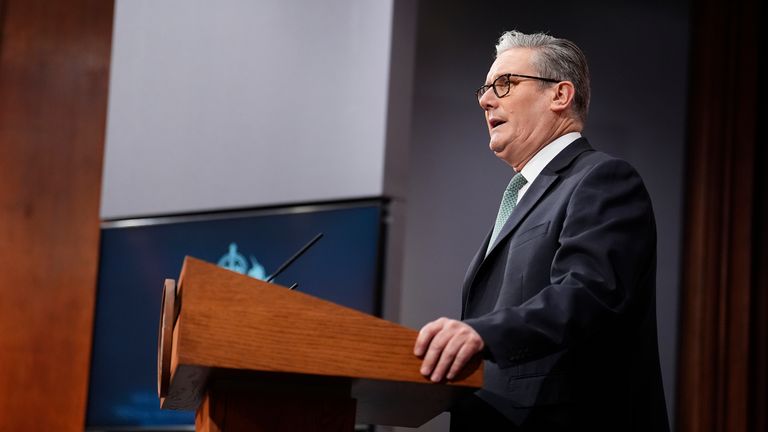
An emergency news conference in the Downing Street briefing room and the prime minister the gravest I’ve seen.
He came to level with the public about the predicament we are in, and the consequences for us all should President Donald Trump follow through on his threat to slap tariffs on the UK and take control of Greenland.
He left the audience in no doubt that we are facing the most serious crisis in the transatlantic relationship in decades, with huge uncertainty about what comes next.
Sir Keir Starmer was the most forthright I have seen him as he broke with President Trump, strongly criticising tariffs and insisting that on the matter of Greenland, the UK would not bend, whatever the consequences as he reminded the US that alliances were built on partnership, “not pressure”.
But the prime minister also used this moment to try to de-escalate, as he stressed the importance of the US-UK relationship and dodged the matter of retaliatory tariffs in an effort to avoid any further poking of the bear.
It doesn’t, by the way, mean the UK has ruled this option out – rather it is not a preferred solution and London would rather talk about other options. But the UK pointedly chose in this moment not to follow the EU by raising the prospect of retaliatory tariffs. That EU package, I’m told, could be released on Thursday.
As I understand it, the prime minister is also “very unlikely” to attend Davos this week, given that there is no big set pieces on multilateral issues – be that Ukraine or Greenland, for now, that are likely to be resolved.
Instead, Keir Starmer will press on with his preferred method – talking intensely behind closed doors while saying as little as possible in public.
Danish minister reveals depth of rift
But if the prime minister doesn’t want to reveal what is being said in private, the gravity of this rupture in the transatlantic alliance was laid bare by the Danish foreign minister and former prime minister, Lars Rasmussen – in London for talks with the foreign secretary – as he recounted the meeting he’d had with Vice President JD Vance and Secretary of State Marco Rubio in Washington last week.
“The meeting we had last week left me with the clear impression that the president, honestly and full-heartedly, wants to acquire Greenland. But we also made it crystal clear that this is a red line,” he told me in an interview after his meeting with Yvette Cooper.
“We agreed to disagree. The concerns raised at the meeting and also in public, about security in the Arctic – [Trump’s] concerns – we want to accommodate. Therefore, we agreed that we should move this dialogue from social media and Truth Social and other arenas into a meeting room where we could discuss whether there could be a solution building on what we already have agreed in the past.”
Up for discussion was the US massively increasing its presence in Greenland, and the stepping up of NATO on the island, as well as guarantees stopping any presence of China in Greenland stretching out for 10, 20 or 30 years.
“I thought, we have managed not to solve the problem, but to find a pathway forward. It was disrupted by the statement from the president. And that’s a reality of life,” said Mr Rasmussen, as he spoke of his appreciation of the UK and other allies coming to stand by the Danes’ side.
Bur what it also reveals is the depth of this transatlantic rift over Greenland.
Hours after the prime minister suggested he didn’t think President Trump would send in troops to Greenland and called on the US to resolve these differences through dialogue, the US president told reporters he would impose 10% tariffs on the UK and other European countries that had sent troops to Greenland for a NATO exercise last week, and refused to rule out military force.
Congress could be Europe’s last hope to rein in Trump
That we are in this situation a year into the Trump presidency is shocking and bewildering. For decades, the transatlantic alliance has framed our world order. Now that is being undone as President Trump exercises the law of power rather than working in the rule of law that has governed international relations since the Second World War.
Escalation in Greenland would rupture the NATO alliance should the leading member move directly into conflict with another partner, the Danes, who stood with the US after 9/11, suffering similar amounts of casualties to the US in Afghanistan.
It would trigger a trade war that would do all of us harm. It could result in the US withdrawing from Ukraine and embolden a Russian aggressor on the edge of Europe. The consequences are as unimaginable as they are serious.
But ultimately, President Trump knows he has the economic and military power to face down Europe, and it will take more than European diplomacy to persuade him to back down.
With the US president due at the annual World Economic Forum summit in Davos on Wednesday, huge attention will be paid to what he has to say in Switzerland – but it will be back in Washington where the difference might be made, as Mr Trump draws fire back home from Republicans in Congress.
If the Europeans can’t rein him in, will his domestic lawmakers?
Republican House Speaker Mike Johnson met with Sir Keir in London on Monday, with the prime minister reiterating his position on Greenland and tariffs.
The best hope the Europeans have is to persuade Congress to act. The transatlantic relationship is, after all, bigger and more enduring than one man.