Bank of England warns of heightened risks but trims banks’ reserve requirements
 by 0
by 0 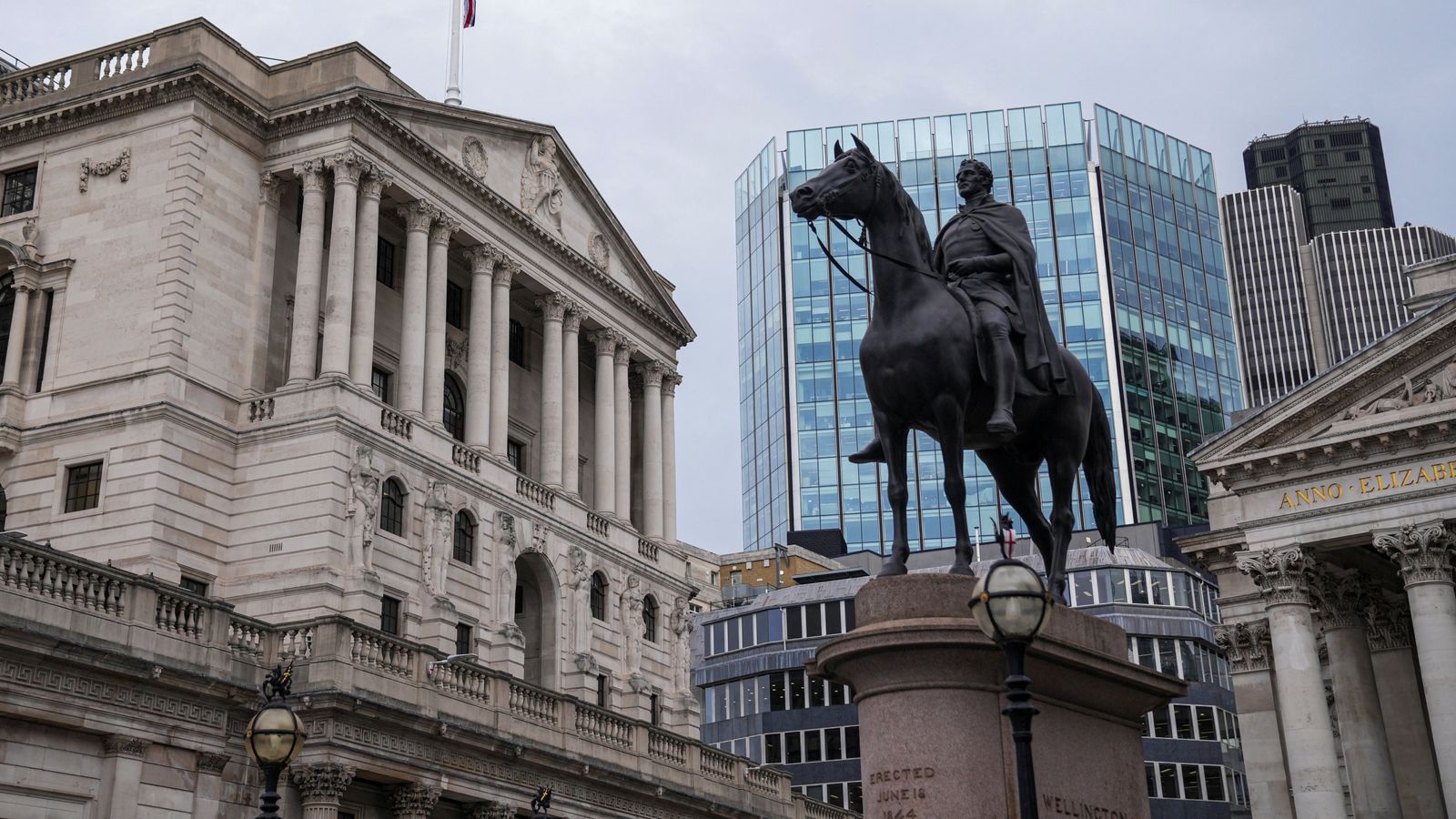

The Bank of England has warned of heightened risks to the UK’s financial system but cut the amount of money that banks need to hold in reserve in case of shock.
The twice-yearly financial stability report highlights a series of pressures, from higher government borrowing costs to risks around lending to major tech firms and record stock market valuations – particularly in areas exposed to artificial intelligence (AI).
“Risks to financial stability have increased during 2025,” the Bank‘s financial policy committee (FPC) said.
“Global risks remain elevated and material uncertainty in the global macroeconomic outlook persists. Key sources of risk include geopolitical tensions, fragmentation of trade and financial markets, and pressures on sovereign debt markets.
Money latest: My supermarket delivery row
“Elevated geopolitical tensions increase the likelihood of cyberattacks and other operational disruptions.
“In the FPC’s judgement, many risky asset valuations remain materially stretched, particularly for technology companies focused on AI.
“Equity valuations in the US are close to the most stretched they have been since the dot-com bubble, and in the UK since the global financial crisis (GFC). This heightens the risk of a sharp correction.”
Its concern extended to the growing trend of tech firms using debt finance to fund investment.
The Bank, which joined the International Monetary Fund in warning over an AI-led bubble in October, delivered its verdict at a time when UK regulators are under pressure from the government to place a greater focus on supporting economic growth.
It is understood, for example, the UK’s ringfencing regime – that sees retail banking separated from more risky investment banking operations within major lenders – is the subject of a review between the Bank and government.
Efforts by the chancellor to grow the economy will be potentially helped by the Bank’s decision today to lower capital requirements – the reserves banks must hold to help them withstand shocks in the financial system such as the global crisis of 2008/9.
The sector’s main capital requirement was cut by the Bank from 14% to 13%.

Such a move was urged, not only by the government, but by businesses to bolster UK lending and competitiveness.
It was announced alongside confirmation that the country’s biggest lenders – Barclays, HSBC, Lloyds, NatWest, Santander UK, Standard Chartered and Nationwide building society – had passed the Bank’s latest stress tests.
The shocks each was exposed to included a 5% contraction in UK economic output, a 28% drop in house prices and Bank rate at 8%.
Despite the growing risks identified by the FPC, the Bank said that each was strong enough to support households and businesses even in the event of such scenarios, given the healthy state of their reserves.
It is widely expected that the gradual reduction in Bank rate will continue next year, assuming the outlook for inflation remains on a downwards trajectory, helping wider borrowing costs – a source of record bank profitability – decline.
The Bank said that three million households were expected to see their mortgage payments decrease in the next three years but that 3.9 million were forecast to refinance onto higher rates.
As such, it projected a £64 (8%) rise in costs for a typical owner-occupier mortgage customer rolling off a fixed rate deal in the next two years.
Banking stocks, which have enjoyed strong gains this year, were up when the FTSE 100 opened for business despite wider market caution globally which is aligned with the risks spoken of in the financial stability report.
Matt Britzman, senior equity analyst at Hargreaves Lansdown, said: “UK banks are offering a dose of optimism this morning in what’s turning out to be a good couple of weeks for the major lenders.
“The UK’s seven biggest banks sailed through the latest stress test, reaffirming their resilience and earning a regulatory nod to ease capital buffers.
“Most banks already hold capital well above the minimum by choice, so any shift in strategy may take time – but in theory, it frees up extra capital for lending or capital returns.
“However they use the new freedom, this is another clear signal that the UK banking sector is in robust health. This was largely expected, but the confirmation should still be taken well, especially after dodging tax hikes in last week’s budget.”