Student loans: The main problems caused by changes announced in the budget
 by 0
by 0 
Changes to the student loans system quietly announced in the last budget have provoked a loud and angry response that has woken up Westminster to what anyone who did a degree in the 2010s, and their parents, already knew.
The debt burden is rising, squeezing young workers as they approach their earning prime.
With around five million people affected, the backlash is likely to grow from next month, when borrowers get the final slice of inflation-linked relief from payments before a three-year freeze on the earnings threshold kicks in, following its announcement by Rachel Reeves in November.
Here, Sky News explains the problems, who is affected and what options there may be to help resolve the difficulties.
Where the problem began…
At the heart of the controversy are Plan 2 student loans, introduced in 2012, when maximum annual tuition fees tripled to £9,000. They were offered until 2023.
Around five million students have a Plan 2 loan and the scheme accounts for around 80% of the £240bn student loan book in England.
Repayments are collected like tax and set at 9% of income above an income threshold – just over £29,000 from April.
Interest accrues on the outstanding debt at the rate of the RPI measure of inflation (not the usually cheaper CPI favoured in other calculations by government), currently 3.2% plus up to 3%, depending on income – far more expensive terms than the previous Plan 1 loans.
After 30 years, if the debt is not cleared, the balance is written off.
Have we not been here before?
As well as being more expensive, Plan 2 terms have been repeatedly changed in recent years. Boris Johnson’s government added the extra 3% to RPI in 2022 and froze thresholds, which, after a brief thaw, Ms Reeves has reimposed.
Why the earnings threshold?
The point of the earnings threshold, and what makes a student loan different from standard borrowing, is to protect lower earners from having to make repayments before they can afford to. By freezing the threshold, the chancellor has increased repayments for all borrowers.
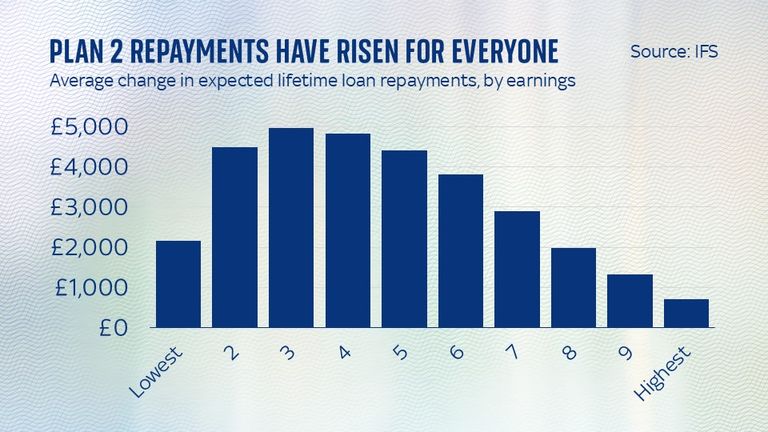
The Institute for Fiscal Studies (IFS) calculates that lifetime loan repayments will rise on average by £3,000, with lower earners worst affected, facing increases of up to £5,000, while the highest earners pay just £700 extra.
The big problem…
Even when they begin repayments, the reality for most borrowers is that the outstanding loan grows far faster than they are able to repay it. Last year, £15bn in interest was added to the loan book against £5bn in repayments.
Unlike a bank loan, where the duration and total repayments can be fixed, student loans are highly variable and depend on personal circumstances. Two people borrowing the same amount of money can repay vastly different amounts over the course of a career.
Read more from Sky News:
Watershed moment as UK levies steel tariff
Unemployment stuck at five-year high
It isn’t working for anyone
Rethink Repayments, a campaign group that has proposed radical changes to the system, has modelled various repayment scenarios that demonstrate how widely circumstances vary.
In their models, a low-earner who borrows £43,000 and starts on an annual salary of £15,000, rising to £85,000 over the course of their career, will repay just £36,000. Their outstanding debt, meanwhile, will have ballooned, with more than £100,000 written off.
A medium-earner who takes the same £43,000 loan but has a salary of £21,000, rising to £110,000, will repay about twice as much, more than £70,000. They only start to bring the total debt down after 25 years, and £90,000 would be written off.
Someone with a salary rising from £27,000 to £142,000 will repay more than £120,000, four times the low-earner, on the same £43,000 of borrowing, and even they will not clear the debt entirely.
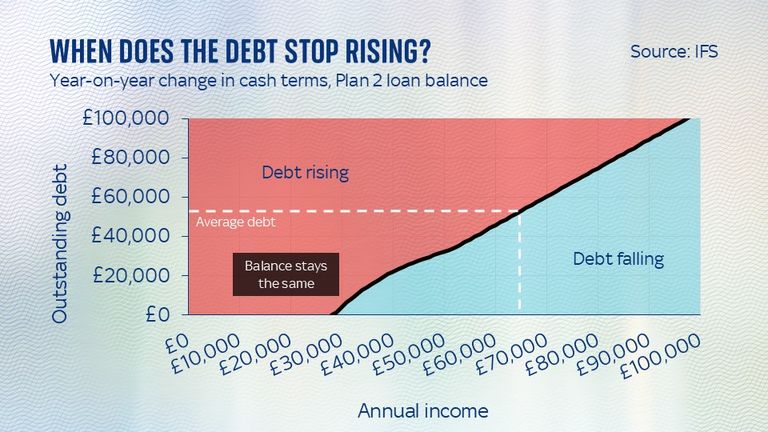
The challenge of lowering a loan balance is illustrated by the fact a graduate who starts their working life with the average student debt of £53,000 has to earn £66,000 before they repay more than they are charged in interest.
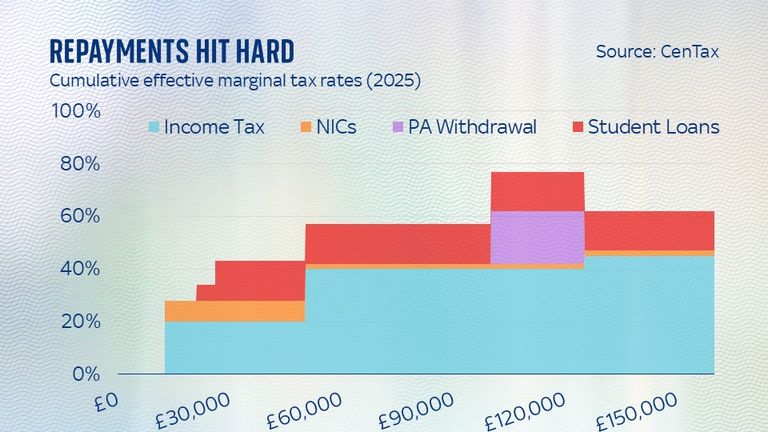
The “graduate tax” repayment mechanism also lands borrowers with punishing marginal tax rates. When they pass the initial earnings threshold they face a marginal rate of 38%, with the 9% loan deduction indeed to income tax and PAYE.
When earnings pass £50,000, the threshold for the higher income tax rate, Plan 2 borrowers face a marginal rate of 51% once the loan deduction is taken, meaning they keep less than half of every extra pound they earn.
Add that to far steeper housing and childcare costs than their parents’ generation, and little wonder graduates who thought a degree might open a path to a prosperous future are feeling squeezed and aggrieved.
The government is not giving ground yet
While the chancellor has defended her changes as “fair”, the prime minister said last month that the government would look at ways of making the loan system “fairer”.
The Treasury has not given guidance on the progress of any review, and it is unclear where the issue sits in the list of political priorities.
What changes could be made?
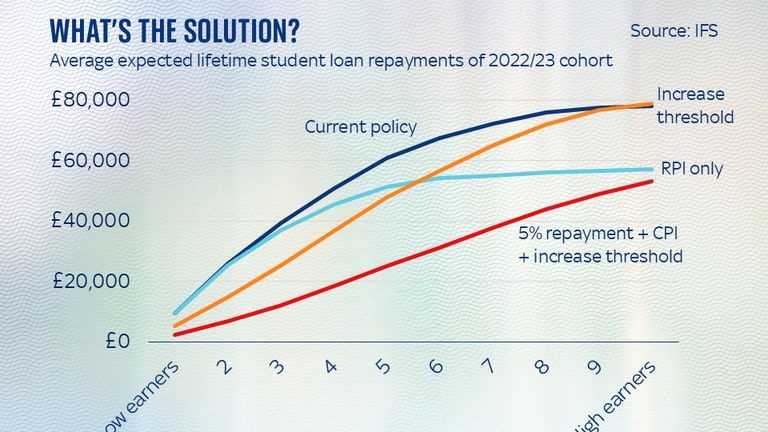
Both main opposition parties have suggested changes. The Conservatives want to revert to RPI without the additional 3%, a move that would not cut repayments now but would reduce lifetime contributions, at a cost to the Exchequer the IFS estimates at £3bn.
The Liberal Democrats, long burned by the reversal of their opposition to tuition fees when in government, would increase the threshold by average earnings, lowering repayments in the short and long term, at a cost of £4bn.
Rethink Repayments wants the threshold restored, to switch the interest rate from RPI to CPI, and cut the repayment rate to 5%. That would drastically reduce lifetime payments and costs and, by the IFS’s calculation, cost around £11bn.
Any of these changes would ease some of the pressure on borrowers and constitute another U-turn, but none of them would wish away the fundamental challenge of higher education funding.
Plan 2 loans may feel iniquitous but they are operating exactly as designed. They put the burden of paying for a degree on the beneficiary, rather than non-graduate taxpayers, and link repayments to earnings.
With many universities running deficits and overseas students underwriting domestic tuition fees that are already too low to cover the cost of teaching, the university sector needs someone to pay its way.