Former Hurricane Rashaun Jones on trial in death of Bryan Pata
 by 0
by 0 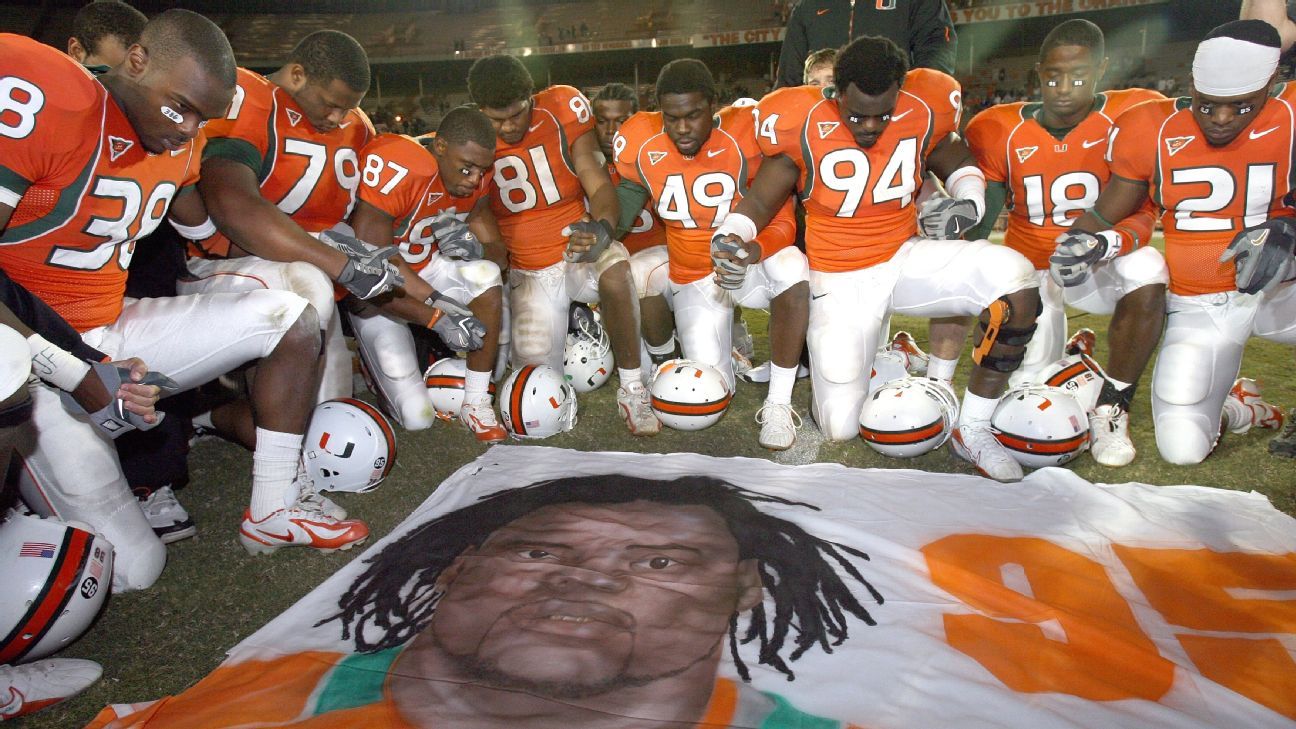

A former University of Miami football player goes on trial for murder Monday, nearly 20 years after his teammate Bryan Pata died of a gunshot wound in the parking lot of his off-campus apartment.
Pata, the youngest of nine children, was a 22-year-old defensive tackle projected to be a second- or third-round NFL draft pick when he was shot in the head Nov. 7, 2006.
Police did not arrest ex-Hurricane Rashaun Jones in Pata’s death until August 2021. State prosecutors charged him with second-degree murder, alleging in the arrest warrant that the teammates had “ongoing issues.”
Jones, 39, has remained in custody for the past 4½ years amid court delays and changes in attorneys on both sides. He has maintained his innocence throughout.
In a pretrial hearing Feb. 2, the state offered a plea deal of 15 years in prison with credit for time served. That is below minimum guidelines in Florida, where Jones could get up to life in prison if convicted for second-degree murder.
Florida 11th Circuit Court Judge Cristina Miranda spoke directly to Jones for several minutes during a pretrial hearing Feb. 2, encouraging him to consider the plea and asking if he wanted to make a counteroffer.
“Some people plead no contest because it’s in their best interest to resolve the case. It means that the gamble is something you’re not willing to take,” she said. “Now, you’re a fairly young man. If this were to resolve, somehow, your life would change because you’re going to have this on your record. But you’ve been in for five years for it now and it’s not like you’re going to go out and have a professional career in football.”
Jones responded to the judge: “Deep down in my heart, I know I’m innocent. If that means I have to go to trial to prove my innocence, I’d be willing to go there,” he said. “Dismissal would be the only thing I am willing to accept.”
In March 2022, Miranda agreed to grant Jones $850,000 bond and allow him out pending trial; however, Jones has not been able to pay the amount — typically 10%, or $85,000 — needed for release, sources with knowledge of the situation told ESPN.
A spokesperson for the Miami-Dade State Attorney’s Office declined to comment on the upcoming trial.
The Pata family, including brother Edwin Pata, said they have believed Jones was guilty since shortly after the killing, and they are looking forward to trial as an opportunity to finally put the shooting behind them.
“It’s constantly on our minds… we’ve just got to be ready for it and know what to expect and be able to handle it,” Edwin Pata said. “Just even sitting through the depositions was hard. You know, he’s nothing to me. And I find myself trying not to give him the energy. … I try to avoid looking at him, but there’s times I can’t avoid just staring at the guy who put the most misery in our family’s life ever.”
Jones’ attorney, Sara Alvarez, declined to comment for this story apart from a statement issued to ESPN: “Rashaun has waited almost 5 years to have his day in court, and now that it has finally arrived, we’ll just echo what Rashaun said … when he rejected the Court’s invitation to plead no contest and resolve his case without a trial: ‘Deep in my heart, I know I’m innocent.'”
Pata’s unsolved killing languished more than 10 years before ESPN began requesting police records in the case amid the Pata family’s growing frustration with investigators’ apparent inaction. Police had said publicly for years that they had no prime suspect and no single person of interest.
According to police records and interviews by ESPN over the years, teammates said Jones and Pata clashed over a woman who had a sexual relationship with Jones before dating and living with Pata, and the two teammates had prior altercations. One of Pata’s brothers has said Jones threatened to shoot Bryan Pata.
Police records noted that Jones was the only Miami football player to not attend a mandatory meeting at the athletic department facilities on the night of the shooting. Jones’ cellphone records contradict his claim that he never left home during the time of Pata’s killing, and the bullet recovered from the shooting was consistent with the type of gun Jones had been seen with previously, according to the arrest affidavit.
Prosecutors also have an eyewitness, retired University of Miami writing instructor Paul Conner, who lived in the apartment complex where the killing happened. Records show he reached out to police the day after the shooting, saying he heard a “pop” noise and he saw someone “jogging” away from the parking lot entrance around 7 p.m., about the time Pata was killed. He also picked Jones out of a photo lineup, police said.
In July 2025, police and prosecutors told Judge Miranda that they had been unable to locate Conner and indicated he was likely dead. Within weeks, ESPN reporters had located Conner, alive and living in Louisville, Kentucky, although with apparent memory challenges that would prevent his testimony. Instead, the judge allowed Conner’s testimony from Jones’ 2022 bond hearing be used at the upcoming trial.
A witness wasn’t the only thing prosecutors said they couldn’t locate. Throughout the pretrial hearings, defense attorneys asked the state for documents pertaining to the case that the state said had either been destroyed or they were unable to locate, even though they had been provided previously to ESPN through records requests.
One of those was an August 2007 polygraph report of jail inmate Bernard Brinson who records show told police that a fellow prisoner had told him he was the one who killed Pata as a hired hitman for $10,000. In a January hearing, Assistant State Attorney Cristina Diamond told the judge they had no record of the document. But in March 2020, Miami-Dade attorneys had provided the document to ESPN, and it noted that Brinson was “truthful in his responses.” ESPN raised the discrepancy with Diamond last week. In a final pretrial hearing Friday, prosecutors acknowledged the document exists but Miranda downplayed its significance, noting that polygraph reports are inadmissible in court.
ESPN sued the Miami-Dade Police Department in 2020 to gain access to the complete and unredacted records, and during proceedings in that case, an officer supervising the investigation said police “have a strong belief who killed Bryan Pata” and had come close to arresting this person at least a decade earlier.
One officer said in court that there could be an arrest “in the foreseeable future, “which police department attorneys said indicated the case was still active, and the records thus protected from disclosure under Florida law.
ESPN published a lengthy story about Pata’s killing in November 2020 that detailed the police record and included other new information about the case, including that police seemed to consider Jones the prime suspect. Jones was arrested about nine months later.
The current lead detective in the case, Juan Segovia, said in a 2024 deposition that police did not uncover any new evidence in the ensuing years that gave them probable cause to arrest Jones in 2021. He said, “It was there all along,” but back in 2007, the state attorney did not feel as though it was enough for an arrest.
ESPN’s investigation uncovered a multitude of leads that police pursued, including a nightclub fight involving possible gang members. The reporting also discovered three alleged murder confessions by other people, including one relayed by federal immigration officials of a man who reportedly died in the 2010 earthquake in Haiti, and another from Brinson, the jail inmate who said a fellow inmate told him he killed Pata for money.
One of the confessions allegedly came from Jones himself to a fellow prisoner while incarcerated after his arrest in 2021. According to documents and interviews with ESPN, that prisoner said Jones told him he confronted Pata out of rage but didn’t intend to kill him.
ESPN’s investigation also identified a number of missteps and inconsistencies by police, including leads that weren’t pursued to the end and people with connections to Pata and that evening who weren’t interviewed.
In the months leading up to trial, prosecutors also said they were unable to produce multiple documents in discovery that police and the county’s attorneys had previously provided to ESPN, including the Brinson polygraph report, and a “lead sheet” that police said listed all of the suspects they investigated. The lead sheet was eventually produced.
But much of that information will not make it to a jury. Prosecutors decided not to have the jailhouse informant who says Jones confessed to him testify. In pretrial hearings over the past few weeks, Judge Miranda decided not to allow evidence regarding the other possible theories and Pata’s other possible interpersonal conflicts, and she ruled to keep out any testimony from hearings over ESPN’s records lawsuit.
While Alvarez argued that she should be able to question whether the police did enough to exclude the other theories, Judge Miranda said the defense failed to gather enough “credible evidence” to tie those leads to this case.
Pata, a Miami native whose parents emigrated from Haiti, grew up in the neighborhood of Little Haiti. His siblings said Pata’s main reason for pursuing a spot in the NFL was to buy his mother, Jeanette, a house after her many years working multiple jobs to take care of her children, of whom Bryan was the baby.
At the University of Miami, the 6-foot-4, 280-pound defensive tackle was projected to be selected in the 2007 NFL draft. He was buried in the suit he had picked out for the event.
On the day of the shooting, Jones had heard from then-head coach Larry Coker that he was being suspended from the team for having failed his second drug test. He and Pata had been at odds before, and according to police documents and interviews with former teammates, Jones got into a fight in a dorm room with Pata, and Jones told him to “clip up.”
Teammates also said that one time, Jones was taunting Pata about his girlfriend Jada Brody, which led to a fistfight in the locker room.
According to the police report, on the night of shooting, Brody said she was inside their apartment cleaning out a dog kennel when she “thought she heard an argument downstairs.”
She left the apartment and walked down to the parking lot, “where she discovered her boyfriend … unresponsive.” Pata was on his back and bleeding on the walkway near his black Infiniti QX56 in its designated parking space. She said she ran upstairs and called 911.
Rescue personnel arrived and pronounced Pata dead at approximately 7:07 p.m. He was shot about 3 inches above and a half inch in front of his left ear. His car keys and phone were on the ground near his body, and a black wallet containing nine $100 bills was in his left front pocket.
Jones has said in a conversation with an ESPN reporter and in questioning by police that he did not kill Pata.
In a videotaped police interview from the day of Jones’ arrest, he said he was upset that day because of the suspension. Jones said he had turned his phone off and then changed his phone number because he was worried about friends and relatives giving him a hard time. Jones denied ever owning or threatening anyone with a gun.
“I know how that could look because of the situation,” Jones said in the interview. “But I’m telling you, I had nothing to do with him dying.”
After jury selection, testimony in the case is expected to start next week.
ESPN’s Dan Arruda and Scott Frankel contributed to this report.