How a century-old Act could help assisted dying supporters override the Lords
 by 0
by 0 
While rare, the Parliament Act can technically be used to pass a private members’ bill if the House of Lords rejects it, provided the bill passes the Commons in two successive sessions and one year elapses.
The Act has been used for landmark, non-government legislation, including the Sexual Offences (Amendment) Act 2000 and the Hunting Act 2004.
Supporters of assisted dying are planning to use the Parliament Act to override the House of Lords if it continues to block the bill.
But how could that work – and do its backers have the power to do that?
What is the Parliament Act?
The House of Lords used to have a complete veto on the Commons. That changed after a row over the blocking of the then chancellor David Lloyd George’s budget in 1909.
It sparked a general election, with Lords reform on the ballot.
The re-elected Liberal government passed the Parliament Act 1911, stripping that veto power in almost all circumstances, though it does allow delay.
In 1949, that delaying power was reduced to a year.
If a bill is passed by the Commons but delayed for longer by the Lords, it can be reintroduced in the following session and passed without the consent of the Lords.
It is different from the Salisbury convention, a practice that means the Lords do not vote down a bill in the government’s manifesto.
When has this been used before?
It’s extremely rare and often relates to deeply contentious issues of the era. Just seven bills have become acts under this procedure.
Most recently, it was used in 2000 for a bill that equalised the age of consent for homosexual acts to 16 and in the Hunting Act of 2004, which banned fox hunting.
Supporters of the private members’ bill to legalise assisted dying are exploring using this if the bill does not pass the Lords in this current session.
Can it be used for a private members’ bill?
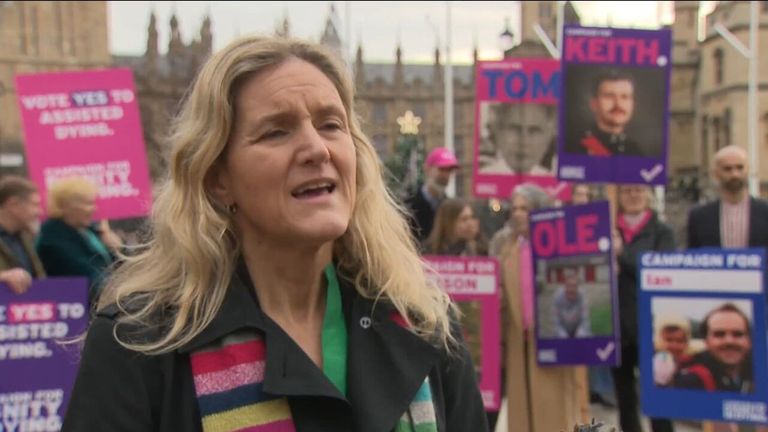
This is unprecedented – and very complicated. But supporters of Kim Leadbeater’s private member’s bill say if the bill has been delayed for more than a year despite passing the Commons, and fails to pass the Lords, there are ways the Parliament Act can apply.
Read more:
What does assisted dying look like?
Assisted dying poses ‘substantial task’ for NHS
The bill will automatically fail if it does not pass the Lords by the end of the parliamentary session – expected in May.
Given the slow progress and more than 1,000 amendments, this looks likely.
That would normally be the end of it, but there are two possible routes for supporters.
The first is if a supporter of the bill brings it back in the next ballot of the private members’ bill.
The second is if the government allocates time to the bill in the next session. It would not have to adopt the bill, and could claim it was still remaining neutral, though opponents would dispute this.
What would be the conditions on the bill?
For the Parliament Act to apply, the bill must be exactly as it was passed by the Commons, though some experts believe there may be some limited and complicated circumstances where amendments are still possible.
It would mean second and third reading votes again in the Commons, but no amendments.
If it passes, peers would still be able to try to stop the bill, but then the Parliament Act to bypass the Lords and enact the bill could be applied.
How likely is it that it will come up again in the ballot?
Pure chance – though the Labour MP John McDonnell did once come top of the ballot twice.
For any private member’s bill to have a chance of passing, Ms Leadbeater or one of her backers would need to come in one of the top five slots – and hundreds of MPs enter the ballot.
How likely is it the government will give it time?
The government has tried to remain strictly neutral on the bill, though Sir Keir Starmer is a supporter of assisted dying.
Ms Leadbeater could put it forward using something called a presentation bill. These are usually largely pointless, as they are not granted any time for debate.
But the government – especially if MPs applied significant pressure – could grant the time for a debate and vote on the basis that it is undemocratic for the Lords to have blocked the bill.
Such action is likely to cause an almighty row, including from Labour backbenchers who oppose the bill. And it might turn some supporters into opponents.
What happens if neither of these options work?
If there is no success in the ballot and the government refuses to play ball, supporters have run out of road.