Can Trump halt Venezuela’s oil production decline?
 by 0
by 0 
Donald Trump has been unambiguous that Venezuela’s huge oil reserves, and the commercial opportunity they represent for American oil companies, were a primary motivation for the removal of President Nicolas Maduro.
Venezuela has the largest reserves on earth, with an estimated 300 billion barrels lying untapped, equating to 17% of global reserves, and more than Saudi Arabia, Iran, Iraq, and more than three times the reserves in the United States.
The bulk of Venezuela’s oil lies in the central Orinoco belt, south of the Orinoco river, in oilfields covering around 50,000sq km that may be the largest hydrocarbon deposit on the planet.
And it is not just how much oil there is, but the type that matters. Venezuelan oil is extra-heavy crude, used for making diesel, jet fuel, asphalt and as a raw material in petro-chemicals.
Venezuela crisis: Follow the latest developments
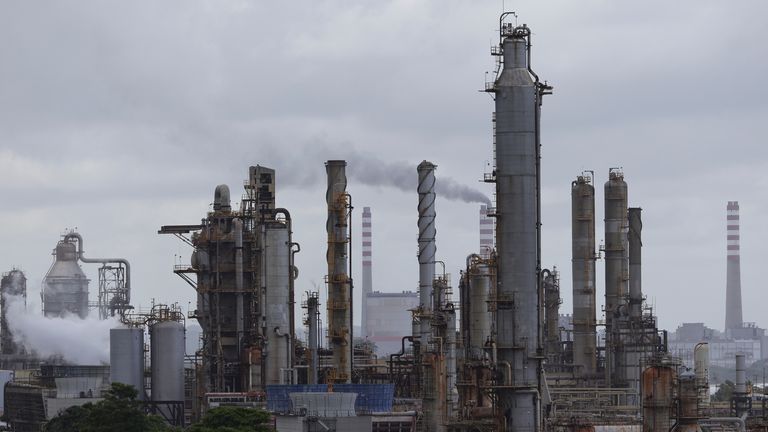
Because it’s highly viscous – thick and sticky – it’s more complex to extract, and requires refinement – but perhaps crucially, while the US does not have large reserves of this kind of crude, it does have refineries that can manage it.
Despite its massive reserves, Venezuelan production is relatively puny and has been in decline for decades.
In the 1960s and 1970s, when, as elsewhere in Latin America and the Middle East, American and British oil companies controlled the industry, production peaked at around 3.5 million barrels a day – around 7% of global output.
Following the election of Hugo Chavez and the nationalisation of the industry, production fell, declining further under his successor Nicolas Maduro and plummeting after the imposition of sanctions in 2019.
Today, Venezuela produces less than one million barrels a day, almost all of which is exported to China, under exemption as repayment for historic loans, and the United States, which has granted oil major Chevron a licence to operate in the country.

Donald Trump says US oil companies will spend billions to reverse that decline, but changing course will take time.
Venezuela’s oil infrastructure has declined through lack of investment and there has been a brain drain of expertise from the domestic industry under Maduro.
Read more:
General reveals how US captured Maduro
Why is Trump so interested in Venezuela’s oil?
Consultants Wood Mackenzie estimate that every additional half a million barrels of extra output will require $15bn-$20bn of investment.
For a sense of how long it might take to significantly increase production, we can look to a previous, albeit much larger episode of US adventurism – the removal of Saddam Hussein in Iraq.
Since the US-led invasion in 2003, Iraqi production has tripled from around 1.5mn barrels a day to almost 4.5m, but it has taken 20 years, and the wider conflict came at an enormous cost to regional stability.
The more immediate question is what impact regime change in Venezuela will have on the oil price when markets reopen this week.
Given the uncertainty over who is really in charge in Caracas, some volatility would not be a surprise, but the US seizure of Venezuelan tankers before Christmas had limited impact.
Oil prices have been falling for a year, down around 20% in 2025 as global demand decreased as economies slowed, leading to over-supply. It’s likely that the prospect of a peace deal between Russia and Ukraine will have more impact on prices than the promise of more Venezuelan crude in decades to come
Whatever happens to markets in the short term, the broader question of whether American involvement in the oil trade amounts to a colonial asset grab, or will ultimately benefit the Venezuelan people, will take longer to resolve.